Introduction: That Excitement Can Be Dangerous
You've found it. A 2018 Honda City, first owner, 55,000 km, priced at ₹7.50 lakh. The photos look clean. The seller sounds genuine on the phone. You're already picturing yourself driving it down the Eastern Express Highway.
But slow down.
In India's used car market, what looks perfect on a listing can hide a world of problems — tampered odometers, outstanding bank loans, flood-damaged engines, or ownership disputes that can leave you holding a car you can't even transfer to your name.
At GaadiJunction, we've seen enough buying horror stories to know one thing for certain: the buyers who get cheated are the ones who were in a hurry. The buyers who got a great deal? They were thorough.
This is your complete used car buying checklist — 15 things you must verify before you pay even a single rupee. Print it out. Screenshot it. Take it with you on every inspection.
1. Verify the RC (Registration Certificate) Matches the Seller
The RC book is the most important document in any used car transaction. The first thing you must do — before anything else — is check that the name on the RC matches the person selling you the car.
Ask the seller to show you the original RC, not a photocopy. Check:
Owner's name matches the seller's Aadhaar/PAN
Engine number and chassis number on the RC match the physical numbers on the car
The registration number is valid and not blacklisted
You can verify the registration on the Government's Vahan portal (vahan.parivahan.gov.in) using just the car's number plate. This is a free service and takes less than 2 minutes. If anything on the RC feels off or the seller is hesitant to show the original, walk away.
2. Check for Hypothecation (Outstanding Bank Loan)
This is one of the most common traps that second-hand car buyers in Mumbai fall into. Hypothecation means the car was purchased on a loan, and the bank's name appears on the RC as a lien holder.
If you buy a car that still has an active loan on it, the bank legally has a claim on that vehicle — even after you've paid the seller.
On the Vahan portal, you can check if there's an active hypothecation on the vehicle. If the RC shows a bank's name under hypothecation and the seller claims the loan is closed, ask for the NOC (No Objection Certificate) from the bank in writing. Without the NOC, do not proceed.
3. Run a Full Insurance History Check
A valid insurance certificate tells you three things: the car is road-legal, what the current IDV (Insured Declared Value) is, and whether there have been any major accident claims in the past.
Ask the seller for the insurance documents and verify:
Policy is currently valid (not expired)
No active claims or major accident history
The car's details match the policy
For a more detailed insurance history, you can ask an insurance broker or use online tools to check prior claim history. A car with multiple major claims in its past is almost always hiding structural or engine damage that wasn't properly repaired.
4. Demand a Pollution Under Control (PUC) Certificate
Buying a car without a valid PUC certificate in Maharashtra is both a legal risk and a red flag about the car's maintenance. Under Mumbai traffic rules, driving without a valid PUC can result in fines — and worse, if the car fails the test, you'll have to invest in repairs immediately after purchase.
A seller who keeps their car's PUC up to date is almost always a seller who maintains the car regularly. It's a small thing, but it tells you a lot about how seriously the owner took routine maintenance.
5. Check Odometer Readings vs. Actual Wear and Tear
Odometer tampering is rampant in India's used car market. A car claiming 45,000 km on the meter but showing heavy wear on the pedal rubber, gear knob, and steering wheel is a car that has been clocked.
Here's how to cross-verify the odometer reading:
Look at wear on the driver's seat, accelerator and brake pedals
Check the service history book — it will have mileage recorded at each service
Old tyres on a "low-mileage" car are a dead giveaway
Have a mechanic pull the car's ECU data — many modern cars store trip records
On GaadiJunction, every listing clearly mentions the kilometres driven, and our sellers are OTP-verified genuine owners — but we still recommend this physical check at the time of inspection.
6. Physically Inspect the Body for Accident Damage
Walk slowly around the car in good natural light. You're looking for:
Uneven panel gaps between doors, bonnet, and boot — this suggests the car has been in an accident and panels were replaced or realigned
Colour mismatch — small differences in shade between panels often mean repaint after an accident
Ripples or waves on the body panels, which indicate dent repair work underneath
Rust spots under wheel arches and along the lower doors — common on Mumbai cars due to coastal salt air and monsoon flooding
Run a magnet along the car's body panels. If the magnet doesn't stick in certain spots, that area has been filled with body filler to hide dents — a classic cheap repair job.
7. Check Under the Hood — Engine and Fluid Condition
You don't need to be a mechanic to do a basic engine check. Pop the hood and look for:
Oil leaks — any dark, greasy residue around the engine block or on the underside
Coolant colour — should be green or orange, not brown or rusty
Engine mounts — look for cracks or excessive rust on rubber mounts
Battery condition — check the terminals for corrosion (white powder)
Belts and hoses — cracked belts or bulging hoses mean expensive repairs ahead
Start the engine cold and listen. Knocking, tapping, or rattling sounds during a cold start are signs of internal engine wear. Blue smoke from the exhaust means burning oil. White smoke could indicate a blown head gasket.
8. Test Drive It — Properly
A test drive of 5 minutes around the block tells you very little. Ask for at least 20–30 minutes and specifically drive:
At highway speeds (60–80 kmph) to check for steering vibration
On a speed breaker to check suspension health
With the AC on and off to check engine response
In reverse, to check the reverse camera or parking sensors if the car has them
While driving, test all windows, mirrors, infotainment, and AC vents. Sit in the back seat too. Check the boot space for spare tyre and jack.
9. Verify the Chassis Number and Engine Number
This step protects you from buying a stolen vehicle. The chassis number (VIN) is stamped on the car's body — usually under the bonnet, on the door sill, or on the dashboard visible through the windscreen. The engine number is stamped directly on the engine block.
Both numbers must exactly match what's written in the RC. Any scratching, re-stamping, or tampered numbers is a serious warning sign of a stolen or scrapped vehicle. Politely decline and report if you find this.
10. Check All Electricals and Accessories
Mumbai traffic means you'll be spending long hours in the car. Make sure every electrical system works:
Air conditioning (check cooling within 2–3 minutes of switching on)
All power windows
Central locking
Headlights, indicators, reverse lights, hazard lights
Infotainment, Bluetooth, and reverse camera if available
Sunroof (if applicable) — open and close it multiple times
Electrical repairs in modern cars are expensive and annoying. If three things don't work on the test drive, expect five more to fail within six months.
11. Check the Tyre Condition and Age
Tyres are expensive — a set of four decent tyres for a mid-size sedan can cost ₹18,000–₹25,000 in Mumbai. Check:
Tread depth — insert a ₹1 coin into the tread groove. If you can see the full coin, the tyres are worn out
Sidewall cracks — small cracks indicate old or sun-damaged tyres
Uneven wear — excessive wear on one side means misalignment or suspension problems
Tyre age — check the manufacture date (4-digit code on the sidewall, e.g., "2318" means 23rd week of 2018)
Also check the spare tyre. A car sold with a flat or missing spare is a car the owner stopped caring about.
12. Verify the Number of Previous Owners
More owners generally means more wear, more stories, and potentially more skeletons. But owner count alone doesn't tell the full story — a 1st owner car driven 1.5 lakh km is worse than a 3rd owner car with 60,000 km.
The RC will show all ownership transfers. Cross-check this with what the seller tells you. If someone claims to be the 1st owner but the RC shows 2 transfers, that's an immediate red flag. Also note how long each owner kept the car — a car that changed hands every 6 months was probably being passed around because of a known problem.
13. Ask for and Verify the Service History
A proper service history is the single best indicator of how well a car was maintained. Ask for the service book or any receipts from authorised service centres. Check:
Were oil changes done regularly (every 10,000–15,000 km)?
Any major component replacements — clutch, timing belt, suspension parts?
Was the car serviced at authorised service centres or just local garages?
If the seller says "service history available on request" — request it before the test drive, not after. Gaps of more than 20,000 km between services are a red flag.
14. Get a Pre-Purchase Inspection from a Trusted Mechanic
Don't rely solely on your own inspection. Before finalising any used car deal in Mumbai, pay ₹500–₹1,500 to get the car inspected by a trusted independent mechanic or at an authorised service centre.
A professional inspection will check things you simply cannot: brake pad thickness, wheel bearing health, engine compression, transmission condition, and detailed underbody rust assessment. This one small expense can save you lakhs in post-purchase repairs.
Many sellers on GaadiJunction actually welcome pre-purchase inspections — because confident buyers close deals faster. A seller who refuses or delays a professional inspection is a seller with something to hide.
15. Negotiate the Right Price Based on All of the Above
Once you've done all 14 steps above, you're finally in a position to negotiate from a place of knowledge rather than hope. Use what you've found to inform your offer:
Worn tyres that need replacement? Deduct ₹15,000–₹20,000 from the ask
Service history has gaps? Negotiate accordingly
Minor scratches or paint work needed? Factor that in
Small electrical issue? Get a quote and deduct it
Never negotiate emotionally. Check the current market price on platforms like GaadiJunction, filter for similar year, mileage, and condition cars in Mumbai, and use real data to support your price. A seller with a genuine car at a fair price will engage reasonably. A seller who refuses any negotiation despite clear flaws is not someone you want to buy from.
Quick Checklist Summary
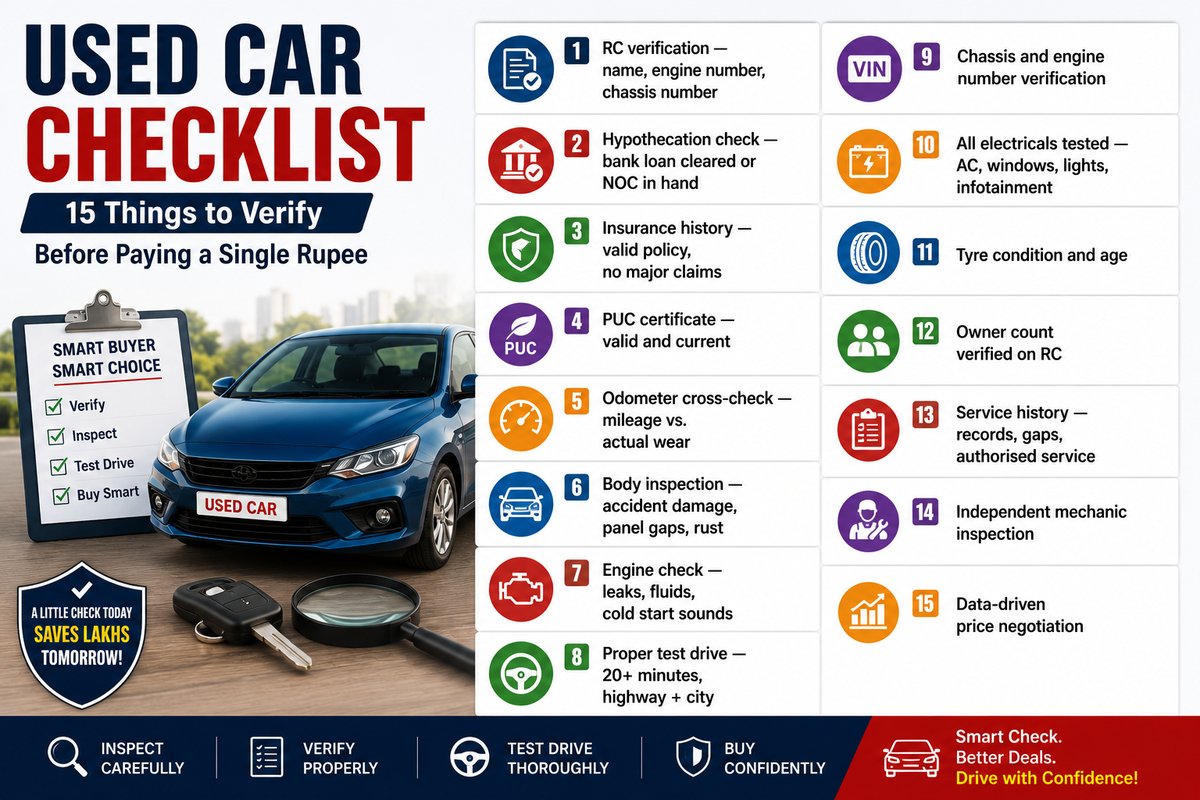
For easy reference on your inspection day, here's the full list at a glance:
RC verification — name, engine number, chassis number
Hypothecation check — bank loan cleared or NOC in hand
Insurance history — valid policy, no major claims
PUC certificate — valid and current
Odometer cross-check — mileage vs. actual wear
Body inspection — accident damage, panel gaps, rust
Engine check — leaks, fluids, cold start sounds
Proper test drive — 20+ minutes, highway + city
Chassis and engine number verification
All electricals tested — AC, windows, lights, infotainment
Tyre condition and age
Owner count verified on RC
Service history — records, gaps, authorised service
Independent mechanic inspection
Data-driven price negotiation
Final Thoughts: Take Your Time, Not Theirs
The biggest mistake used car buyers in Mumbai make is letting the seller control the timeline. "Someone else is coming to see it today." "Price will go up tomorrow." These are pressure tactics designed to stop you from thinking clearly.
A good car at a fair price will still be a good car tomorrow. Do your checklist. Bring a mechanic. Verify every document. And only pay when you're fully confident.
GaadiJunction lists only OTP-verified sellers with real photos and honest descriptions. Every listing on our platform links you directly to the owner. But even with verified listings, we always tell our buyers: your checklist is your best protection.
Browse verified used cars in Mumbai on GaadiJunction — and buy with confidence.